The Modular AI Stack: Enterprise-Grade AI Agents for SMBs
Deploy enterprise-grade AI agents for just $10-20/month using a modular 4-layer stack. No vendor lock-in, full data privacy, and unlimited customization for SMBs.
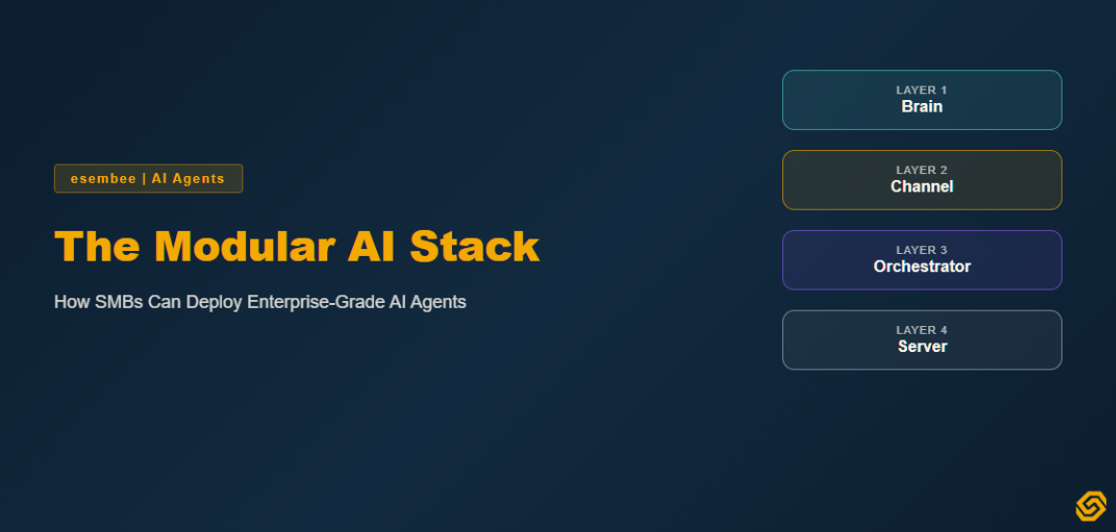
The Modular AI Stack: How SMBs Can Deploy Enterprise-Grade AI Agents
TL;DR: The modular AI stack is a 4-layer architecture (Brain, Channel, Orchestrator, Server) that lets small businesses deploy enterprise-grade AI agents for $10-20 per month, compared to $300-500 for enterprise SaaS solutions. This approach eliminates vendor lock-in, provides full data privacy through local model options, and offers unlimited customization. With infrastructure costs as low as $10-12 per month on a VPS and open-source frameworks like Hermes Agent, SMBs can automate content creation, research, documentation, and strategic tasks without hiring developers.
The result: enterprise capability at small business prices, with the security and control that modern data governance demands.
Why SMBs Need AI Agents (Not Just Chatbots)
Chatbots answer questions. AI agents execute tasks.
The difference is autonomy. An AI agent can:
- Read and write files on your system
- Execute shell commands and scripts
- Connect to APIs and external services
- Learn from feedback and build reusable skills
- Operate 24/7 without human intervention
For SMBs, this means automating repetitive, high-volume tasks that currently require headcount or expensive SaaS tools. According to Digital Applied (2026), businesses implementing AI agents report average efficiency gains of 40% and cost reductions of 30% within the first year. The technology has matured beyond the experimentation phase. The question is no longer whether AI agents work. It is how quickly you can deploy them.
The 4-Layer Modular Architecture
The power of the modular AI stack lies in its separation of concerns. Each layer handles a specific function, and you can swap, upgrade, or replace any layer independently. This is the opposite of vendor lock-in. It is architecture by design.
Layer 1: The Brain
Open-source AI models that power the thinking. Options include:
- Local models via Ollama or llama.cpp (free, fully private)
- Cloud models via API (Opencode Go or Zen packs, OpenRouter, Anthropic, OpenAI)
- Hybrid routing (local for sensitive data, cloud for complex reasoning tasks)
The Brain layer gives you control over cost, privacy, and capability. Run sensitive operations on local hardware. Route complex reasoning to cloud APIs only when needed. This hybrid approach is something enterprise SaaS platforms cannot match.
Layer 2: The Channel
Your assistant lives where you already work:
- Telegram (most popular for AI agents)
- Slack (team integration)
- WhatsApp (client communication)
- Discord (community management)
No new app to learn. No training required. The Channel layer meets your team in their existing workflow, reducing adoption friction to zero.
Layer 3: The Orchestrator
Frameworks like Hermes Agent from Nous Research coordinate multiple AI specialists:
- Content creator
- Research analyst
- Documentation writer
- Strategic consultant
Each handles a specific job. The orchestrator routes tasks intelligently based on complexity, data sensitivity, and required capability. This is where the "team of AI agents" concept becomes operational reality.
Layer 4: The Server
Runs 24/7 on affordable infrastructure:
- Virtual machine: $10-12/month (DigitalOcean, Docker)
- Local machine: free (if always on). Old computers are useful here, minimal capabilities required.
- Raspberry Pi: $50 one-time cost
The Server layer is where most businesses overpay. Enterprise SaaS bundles infrastructure with markup. The modular stack separates them, giving you direct control over hosting costs.
Security: From Luxury to Necessity
The biggest barrier to AI agent adoption has been security. Agents need access to your systems to be useful, but that access creates risk.
NVIDIA OpenShell solves this with enterprise-grade sandboxing:
- Filesystem Isolation: Agents can only read/write explicitly allowed paths.
- Network Control: Default-deny outbound. Hot-reloadable proxy policies.
- Credential Management: API keys injected at runtime only. Never touch disk.
- Process Security: Blocks privilege escalation and dangerous syscalls.
- Infrastructure-level enforcement: The agent cannot override the security layer.
OpenShell is open-source (github.com/NVIDIA/OpenShell) and integrates natively with Hermes Agent. This is not a nice-to-have. For any business handling customer data, financial records, or proprietary information, sandboxing is a compliance requirement, not an optional feature.
Cost Analysis
| Approach | Monthly Cost | Lock-in | Privacy | Customization |
|---|---|---|---|---|
| Enterprise SaaS | $300-500 | High | Low | None |
| ChatGPT Team | $25-60/user | Medium | Medium | Limited |
| Modular AI Stack | from $10-20 | None | Full | Unlimited |
The numbers tell the story. A modular AI stack costs 90-95% less than enterprise SaaS alternatives while delivering superior privacy, zero lock-in, and unlimited customization. For a team of five, the annual savings compared to enterprise SaaS exceed $16,000. That is not a rounding error. It is a budget line item that funds growth.
The ROI equation is straightforward: At $15 per month for infrastructure and $0 for open-source software, even a single automated workflow that saves 4 hours per week pays for the entire stack in under one month. Scale that across multiple workflows and the compounding returns become significant.
Implementation Roadmap for Non-Technical Founders
Most AI projects fail because implementation lacks structure. Here is a proven 4-week roadmap designed for non-technical founders.
Week 1: Foundation
- Install Hermes Agent on desktop or CLI in your OS (one command)
- Configure your SOUL.md (brand voice, expertise, preferences)
- Connect to Telegram or Slack
Week 2: First Workflow
- Choose one repetitive task (content, research, or documentation)
- Create a SKILL.md for it
- Test and iterate
Week 3: Expansion
- Add more workflows
- Connect external tools (Google Analytics, social media, CRM)
- Set up cron jobs for automation
Week 4: Production
- Wrap in OpenShell for security
- Set up monitoring and alerting
- Document processes
Start small. Prove value. Expand methodically. This is the pattern that works.
Case Studies
Marketing Agency (Solo Operator)
Deployed specialized agents for SEO, Ads, Social, and Email on a $10/month VPS. Automates client work that previously required 3 hires. Annual savings: $120,000+ in salary and benefits. The operator now handles 4x the client load with the same workload.
Real Estate Broker
Agent scrapes listings, generates AI video walkthroughs, calculates commissions, and sends personalized outreach. Closes deals with zero manual sourcing. Time saved: 15-20 hours per week previously spent on property research and lead follow-up.
Content Creator
YouTube video goes to auto-transcribe, then generates 15-20 platform-specific content pieces. Agent learns the creator's style through feedback. Content output increased 800% while maintaining brand consistency across every platform.
Why This Matters for SMBs
The modular AI stack is not a technical curiosity. It is a competitive equalizer. According to First Page Sage (2026), 80% of small and medium businesses are in the experimentation phase with AI, while 25% of enterprises have already deployed agentic AI at scale. The gap is closing, but only for businesses that act now.
Small businesses that adopt modular AI infrastructure gain three structural advantages: cost efficiency (90-95% lower than enterprise alternatives), data sovereignty (your data stays on your infrastructure), and adaptability (swap any layer as your needs evolve). These are not incremental improvements. They are the foundation for competing against larger, better-funded competitors on operational capability.
The businesses that deploy AI agents today will compound their advantages over the next 12-24 months. Those that wait will face higher adoption costs, steeper learning curves, and competitors who have already optimized their operations with autonomous AI systems. The modular approach removes the excuses. No massive budget required. No technical team required. No vendor lock-in. Just a clear architecture, open-source tools, and a willingness to start.
FAQ: The Modular AI Stack
- What is the modular AI stack?
The modular AI stack is a 4-layer architecture for deploying AI agents. The Brain layer handles reasoning (using local or cloud models). The Channel layer connects to your existing communication tools (Telegram, Slack, WhatsApp). The Orchestrator layer coordinates multiple specialized AI agents. The Server layer provides affordable, always-on infrastructure. Each layer is independent and swappable.
- How much does it cost to deploy?
Infrastructure costs range from $10-20 per month for a VPS, or free if you use an always-on local machine. Software costs are close to zero because the stack runs on open-source frameworks like Hermes Agent and yuo can pick any LLM model from low cost suppliers like Opencode or OpenRouter to name a few. Compare this to enterprise SaaS at $300-500 per month or ChatGPT Team at $25-60 per user. The modular stack delivers enterprise capability at small business prices.
- Do I need technical skills to use it?
No. Hermes Agent is designed for non-technical founders. Installation requires one command. Configuration uses a plain-text SOUL.md file where you describe your brand voice, expertise, and preferences. The implementation roadmap in this guide is designed for founders with zero programming experience.
- What is the difference between this and enterprise AI?
Enterprise AI solutions bundle infrastructure, models, and support into a single expensive package with vendor lock-in. The modular AI stack separates these concerns. You choose your own models, host on affordable infrastructure, and own your data completely. The result is 90-95% cost savings with superior privacy and customization.
- How long does implementation take?
The basic stack is operational in under one week. Full production deployment with security sandboxing takes approximately 4 weeks. The implementation roadmap in this guide provides a step-by-step schedule designed for non-technical founders.
- What about data privacy and security?
The modular stack provides full data privacy because you control where data is processed. Local models (via Ollama or llama.cpp) keep sensitive data on your hardware. NVIDIA OpenShell adds enterprise-grade sandboxing: filesystem isolation, network control, credential management, and process security. Your data never leaves your infrastructure unless you explicitly route it to a cloud API.
- Which layer should I start with?
Start with the Server layer. Deploy Hermes Agent on a $10-12/month VPS or your local machine. Then configure the Brain layer with a local model for privacy-sensitive tasks. Connect the Channel layer to your existing communication tool (Telegram is most popular). Finally, add the Orchestrator layer as you build multiple specialized agents. The architecture is designed to be adopted incrementally.
Start Building Your AI Stack Today
Book a free consultation with esembee. We will assess your current setup, identify your real needs and highest-value automation opportunities, and recommend the right modular stack configuration for your business.
Join the esembee community following us in social media. Get access to frameworks, case studies, and peer insights from SMB leaders who are building their AI infrastructure right now.
Your AI assistant is one conversation away. The modular stack makes enterprise-grade capability accessible at small business prices. The only question is whether you start today or wait for your competitors to do it first.