AI Agents for Small Business: The Non-Technical Founder's Implementation Guide
An AI agent observes data, reasons through decisions, and acts autonomously. SMBs report 40% efficiency gains and 30% cost reductions in the first year.
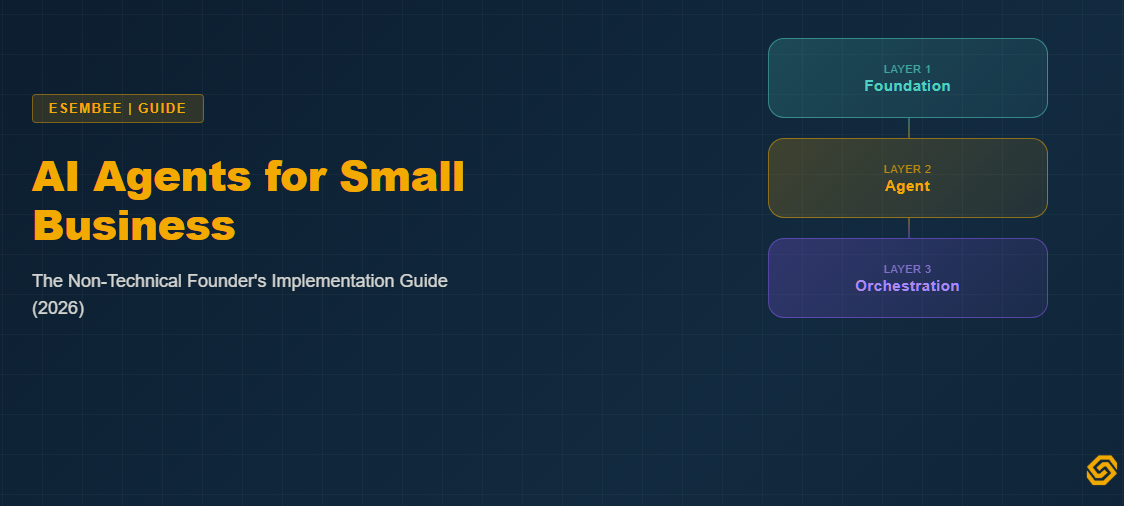
AI Agents for Small Business: The Non-Technical Founder's Implementation Guide (2026)
TL;DR: An AI agent is a software system that observes data, reasons through decisions, and takes action autonomously within defined guardrails. For small businesses, this means automating repetitive workflows, qualifying leads, managing follow-ups, and handling customer support without hiring additional headcount. SMBs implementing AI agents report 40% efficiency gains and 30% cost reductions within the first year. This guide gives you a 90-day roadmap, realistic cost breakdown, and the frameworks to build your first AI team, even without a technical background.
Want the free guide? Download it here.
What Are AI Agents (And Why They're Not Just Chatbots)
An AI agent for small business is an autonomous software system that perceives its environment, reasons through objectives, and executes multi-step tasks without requiring human intervention for every action. Unlike a chatbot that responds to prompts, an AI agent maintains context, makes decisions across workflows, and coordinates with other systems to achieve business outcomes.
Think of it this way: a chatbot answers a question. An AI agent completes a job.
AI Tools vs AI Agents: The Key Difference
Understanding this distinction matters because most small business owners conflate "AI" with "chatbot" and dismiss the technology before they see what is actually possible.
| Feature | AI Tools (Chatbots) | AI Agents |
|---|---|---|
| Input | Single prompt/response | Continuous observation of data |
| Decision Making | Rule-based or reactive | Autonomous reasoning within guardrails |
| Task Scope | One task at a time | Multi-step workflows across systems |
| Learning | Static knowledge base | Adapts based on outcomes and feedback |
| Integration | Standalone or limited | Connects to CRM, email, accounting, and operations tools |
| Human Dependency | Requires prompt for every action | Operates independently, escalates when needed |
| Outcome | Information delivery | Task completion and workflow execution |
An AI agent doesn't just tell you a lead looks promising. It qualifies the lead, enrolls them in a nurture sequence, updates your CRM, and schedules a follow-up call with your sales team. All without you lifting a finger.
Why 82% of Small Businesses Think AI Isn't for Them (And Why They're Wrong)
According to the SBA Office of Advocacy (2025), 82% of small businesses believe AI is not relevant to their operations. This perception gap exists for three reasons:
- The enterprise narrative dominates. Most AI coverage focuses on Fortune 500 companies with dedicated data science teams. Small business use cases rarely make headlines.
- "AI" sounds technical. The word itself creates an intimidation barrier, even though no-code AI agents now require zero programming knowledge.
- Past tool fatigue. Many SMB owners have been burned by software that promised transformation and delivered complexity.
Here is the reality: the tools have caught up with the narrative. Non-developer adoption of AI agents grew 137x since August 2025 (OpenAI, 2026). The barrier is no longer capability. It is awareness.
The AI Agent Market in 2026: By the Numbers
The market data tells a clear story:
- AI agent market size: $7.6 billion in 2025, projected to reach $236 billion by 2034 (Digital Applied, 2026)
- Agentic AI specifically: $5.25 billion in 2024, projected to reach $199 billion by 2034 at a 43.84% CAGR
- Enterprise adoption: 25% of enterprises are already using agentic AI (First Page Sage, June 2026)
- SMB adoption: 80% of small and medium businesses are in the experimentation phase (First Page Sage, June 2026)
- Enterprise app integration: 40% of enterprise applications will use AI agents by end of 2026 (Gartner, 2026)
- SMB AI usage growth: 40% to 58% in a single year
The window for early-mover advantage is closing. SMBs that implement now capture cost savings and efficiency gains that compound over time. Those that wait will be competing against AI-augmented businesses without the same operational leverage.
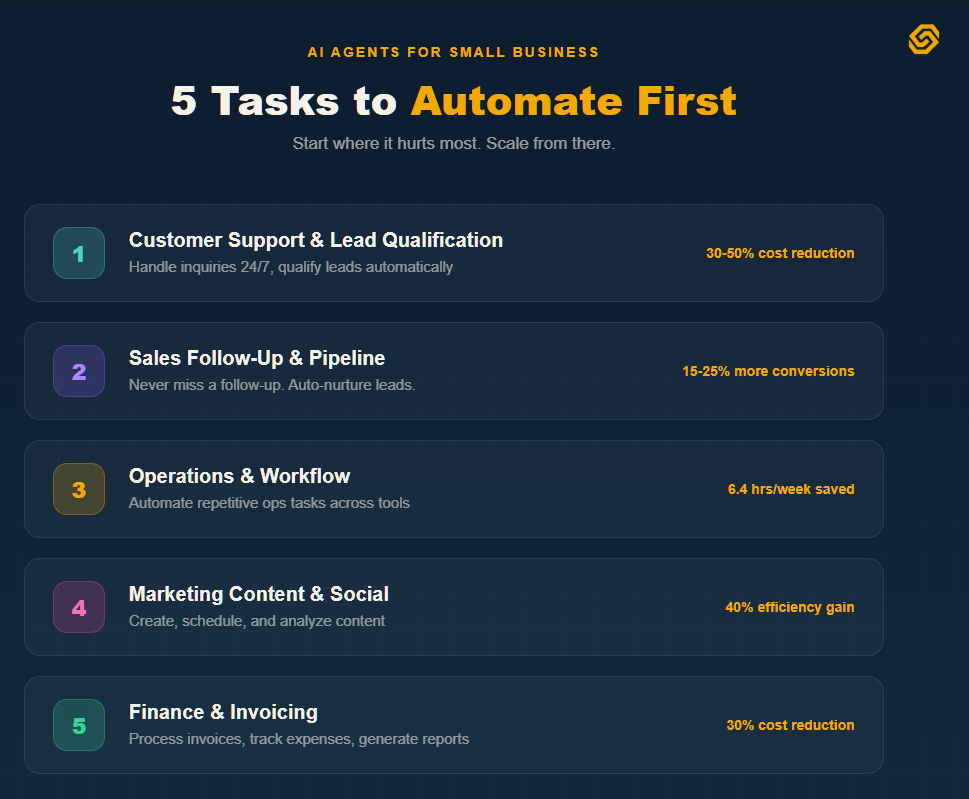
The 5 Highest-ROI AI Agents for Small Businesses
Not every AI agent delivers equal value. Based on implementation data and SMB use cases, these five agent categories produce the highest return on investment for small businesses.
Agent 1: Customer Support and Lead Qualification
- What it does: Handles inbound inquiries across email, chat, and social channels. Qualifies leads based on predefined criteria. Routes complex issues to human team members. Maintains conversation history across touchpoints.
- Why it ranks first: Customer support is the most labor-intensive, repetitive function in most small businesses. An AI support agent resolves 60-80% of common inquiries autonomously while maintaining response times under 30 seconds, 24/7.
- ROI signal: Reduce customer support costs by 30-50% while improving response time and satisfaction scores.
Agent 2: Sales Follow-Up and Pipeline Management
- What it does: Monitors pipeline stages. Sends personalized follow-up sequences. Updates CRM records. Alerts sales reps when leads show buying signals or when deals stall. Forecasts revenue based on pipeline data.
- Why it ranks second: Sales follow-up is where most small businesses lose revenue. Studies show that 80% of sales require five or more follow-ups, but most reps stop after two. An AI sales agent never forgets.
- ROI signal: Increase pipeline conversion rates by 15-25% through consistent, timely follow-up.
Agent 3: Operations and Workflow Automation
- What it does: Connects tools that don't naturally talk to each other. Automates data entry between systems. Triggers actions based on conditions (e.g., when an invoice is paid, update inventory and send a thank-you email). Monitors processes and flags anomalies.
- Why it ranks third: Operations automation eliminates the "busy work" that consumes 30-40% of a small business team's week. These hours represent direct labor cost savings.
- ROI signal: Save 6.4 hours per week per knowledge worker. For a team of five, that is 32 hours reclaimed monthly.
Agent 4: Marketing Content and Social Media
- What it does: Generates content drafts based on brand guidelines and audience data. Schedules and publishes across platforms. Monitors engagement metrics. Adapts content strategy based on performance data. Repurposes long-form content into social posts, email snippets, and ad copy.
- Why it ranks fourth: Content production is a constant demand with diminishing returns for most SMBs. An AI marketing agent maintains consistent output without the overhead of a full content team.
- ROI signal: Reduce content production costs by 40-60% while increasing publishing frequency.
Agent 5: Finance and Invoicing
What it does: Automates invoice generation and delivery. Categorizes expenses. Reconciles transactions. Flags anomalies in cash flow. Generates financial reports on schedule. Sends payment reminders.
Why it ranks fifth: Finance is lower volume but high impact. Errors in invoicing and expense tracking compound quickly. An AI finance agent reduces errors and frees up hours of bookkeeping work monthly.
ROI signal: Reduce invoicing errors by 90% and save 4-8 hours per month on bookkeeping tasks.
How Much Do AI Agents Cost? A Realistic Breakdown
Cost is the first question every SMB founder asks. Here is the honest answer.
No-Code Solutions: $100-$500/Month
Platforms like Make, Zapier, and dedicated AI agent builders offer pre-built templates that non-technical users can configure in hours. These solutions work well for single-function agents (e.g., lead qualification or social media scheduling) but lack the orchestration capability of more robust systems.
- Best for: Solo founders, teams under 10, businesses testing AI for the first time.
Managed Services: $3,000-$12,000 Setup
A managed AI agent service includes custom configuration, integration with your existing tools, training on your business data, and ongoing optimization. This is the "done-for-you" option where a provider builds, deploys, and maintains your agents.
- Best for: Teams with 10-100 employees, established processes, and budget for operational improvement.
Custom Development: $15,000+
Full custom AI agent development involves building proprietary systems tailored to your specific workflows. This approach delivers the highest capability but requires significant upfront investment and ongoing maintenance.
- Best for: Businesses with unique workflow requirements, compliance needs, or scale that off-the-shelf solutions cannot address.
The ROI Equation: When Does It Pay Off?
The math is straightforward:
- Average ROI of AI agents: 171%
- Average payback period: 4 to 9 months
- Efficiency gains for SMBs: 40% efficiency gains plus 30% cost reductions
If you invest $5,000 in a managed AI agent solution and it saves your team 6.4 hours per week at an average loaded cost of $35/hour, you recover your investment in under 6 months. After that, every month is net positive.
Your 90-Day AI Agent Implementation Roadmap
Most AI projects fail not because the technology doesn't work, but because the implementation lacks structure. Here is a proven 90-day roadmap.
Week 1-2: Audit Your Workflows
- List every recurring task your team performs weekly
- Identify which tasks are repetitive, rules-based, and time-consuming
- Map which tools and systems each task touches
- Rank tasks by hours consumed and revenue impact
- Select the top three candidates for automation
Week 3-4: Choose Your First Agent (Start Small)
- Match your highest-priority workflow to an AI agent category
- Evaluate two to three platforms or service providers
- Request demos and pilot access
- Define success metrics before deploying (time saved, cost reduced, errors eliminated)
- Choose one agent, one workflow, one clear outcome
Week 5-8: Deploy and Integrate
- Configure your AI agent with your business data and processes
- Integrate with existing tools (CRM, email, accounting, project management)
- Set human oversight checkpoints (approval triggers, escalation rules)
- Run a controlled pilot with a subset of your workflows
- Document issues and adjust configurations weekly
Week 9-12: Measure, Optimize, Scale
- Compare actual results against your success metrics
- Gather team feedback on the agent's performance
- Optimize prompts, rules, and integrations based on data
- Expand the agent's scope or add a second agent to a new workflow
- Build your AI operating system by connecting agents into coordinated workflows
Common Mistakes (And How to Avoid Them)
Mistake 1: Trying to Automate Everything at Once
Scope creep kills AI projects. Start with one agent, one workflow, prove the value, then expand. The 90-day roadmap above exists for this reason.
Mistake 2: Ignoring Your Data Foundation
AI agents are only as good as the data they access. If your CRM is a mess, your support agent will pull from outdated records. If your accounting data is inconsistent, your finance agent will produce unreliable reports. Clean your data before you automate.
Mistake 3: No Human Oversight Framework
Every AI agent needs defined escalation triggers. Without them, errors compound silently. Build approval checkpoints into every agent's workflow. Review agent performance weekly during the first 90 days.
Mistake 4: Choosing Tools Over Strategy
A platform is not a strategy. Before evaluating any tool, define the business outcome you want. Then find the agent that delivers it. Too many SMBs buy software and then look for a problem to solve with it.
Real Results: What SMBs Are Achieving with AI Agents
Case Study Framework
- The problem: A 12-person consulting firm spent 15 hours per week on manual lead qualification and follow-up. Leads dropped through cracks. Response times averaged 48 hours.
- The solution: Deployed a customer support and lead qualification agent integrated with their CRM and email platform. Configured qualification criteria based on their ideal client profile. Set up automated follow-up sequences with human escalation triggers.
- The result: Lead response time dropped to under 5 minutes. Qualification accuracy improved by 35%. The sales team reclaimed 15 hours per week to focus on closing deals. First-year ROI: 195%.
This is the pattern we see across SMB implementations: targeted automation, measurable outcomes, compound returns.
Key Metrics to Track
- Time saved per week (hours reclaimed per team member)
- Cost per interaction (support, sales, operations)
- Response time (lead response, customer support, internal requests)
- Error rate (data entry mistakes, missed follow-ups, invoicing errors)
- Conversion rate (lead to customer, inquiry to resolution)
- Revenue impact (pipeline growth, upsell detection, churn reduction)
- Team satisfaction (are your people spending time on higher-value work?)
FAQ: Everything You Need to Know About AI Agents for Small Business
- What is an AI agent for small business?
An AI agent for small business is an autonomous software system that observes business data, makes decisions within defined rules, and executes multi-step tasks across tools like CRM, email, and accounting platforms. Unlike chatbots, AI agents complete entire workflows without human intervention for every step.
- How much does it cost to implement AI agents in a small business?
No-code AI agents cost $100 to $500 per month. Managed services range from $3,000 to $12,000 for setup and configuration. Custom development starts at $15,000. Most small businesses see a payback period of 4 to 9 months with an average ROI of 171%.
- Do I need technical skills to use AI agents?
No. Non-developer adoption of AI agents has grown 137x since August 2025. Modern no-code platforms allow non-technical founders to configure, deploy, and manage AI agents using visual interfaces and templates.
- What is the difference between a chatbot and an AI agent?
A chatbot responds to individual prompts within a conversation. An AI agent autonomously executes multi-step workflows across multiple systems, makes decisions based on data, and completes tasks without requiring a human prompt for every action.
- Which AI agent should I implement first?
Start with customer support and lead qualification. This function is repetitive, rules-based, high-volume, and directly impacts revenue. It is also the easiest to measure for ROI.
- How long does it take to see results from AI agents?
Most SMBs see measurable results within 2 to 4 weeks of deployment. Full ROI typically materializes within 4 to 9 months, depending on implementation complexity and workflow volume.
- What are the risks of implementing AI agents?
The primary risks are poor data quality, lack of human oversight, and trying to automate too many workflows simultaneously. Mitigate these by cleaning your data first, building escalation triggers into every agent, and starting with one workflow before expanding.
Start Building Your AI Team Today
Next Steps
- Book a free consultation with esembee. Contact us — we will assess your current workflows, identify your highest-ROI automation opportunities, and recommend a tailored implementation plan.
- Join the esembee community. Get access to case studies, frameworks, and peer insights from SMB leaders who are building their AI teams right now.
The question is not whether AI agents will transform small business. The data is clear. The question is whether you will be an early adopter who captures the advantage or a late follower who pays a premium to catch up.
AI Agent Implementation Framework
90-day roadmap, workflow audit worksheets, agent selection criteria, and ROI calculation templates.
Ready to implement this in your business?